Cover 1 Explained: Man Free, and the Robber Behind It
The E48 cheat card teaches Cover 1 as man coverage underneath with one free safety on top. That is correct, and it is one of the most dependable reads in football.
It is also only half the picture. Cover 1 is not one call, it is a family, and the difference between its members is a single defender who has no receiver at all. Where that man stands decides which of your throws is free and which one is a turnover.
The base picture, with numbers
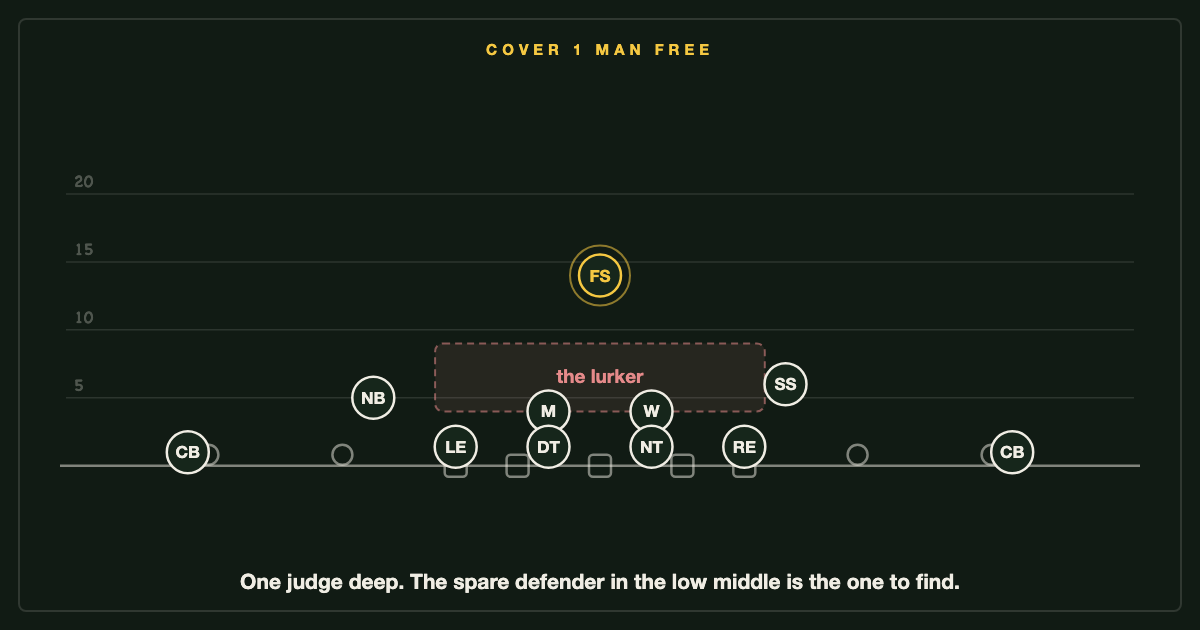
Man coverage underneath, one free safety in the deep middle, and a spare defender if the defense is not blitzing. Bowen calls it a first day install, with defenders playing man from outside leverage and using the free safety in the middle of the field.
The alignments are consistent enough to memorize. Corners in off man play an outside shade at seven to eight yards. The free safety sits between the hashes at twelve to fifteen yards, which two independent sources agree on, and Saban describes starting him at about fifteen. The strong safety takes outside leverage on the second receiver, often the tight end. The Mike works as an underneath hole defender.
Notice the leverage is the mirror image of Cover 0. Here the corners shade outside and funnel you inside, because inside is exactly where the help is standing.
The techniques that tell you it is man
Two coaching details give this coverage away, and both are visible.
The flat foot read. In off man, corners do not start their backpedal until the receiver has cleared the three step concepts, the slant and the hitch. A corner standing still at seven yards while the play develops is not lazy, he is executing.
The full man turn. Saban's requirement is that the corner turns until his shoulders are parallel to the line of scrimmage and his back is to the ball, and that he completes that turn quickly. A defender who turns his back on the quarterback has told you he has no zone responsibility, because a zone defender never stops seeing the ball.
The free safety has his own tell. Saban's key is that he reads the releases of both second receivers in a two by two set, or the second and third in trips, before he ever looks at the quarterback. His eyes go to routes first and the passer second.
The Robber, and who it actually is
Add one free hunter in the low hole reading the quarterback's eyes and you have Cover 1 Robber, also called Rat.
Who that defender is turns out to be contested, and the disagreement is real rather than sloppy. One reading has the Rat as a linebacker lurking near the line, which matches Saban's rule where the far hook player becomes the Rat. Another reading has Robber meaning specifically the strong safety dropping down. Both usages exist in print. Defense IQ draws the Will, and the honest thing is to say so rather than pretend the term is settled.
Depth is more interesting than it looks. The middle linebacker version sits around eight yards off the line. But Saban's One Cross places the same player at the sticks, meaning the first down marker, which makes his depth a function of down and distance rather than a fixed number.
That is worth sitting with. On third and twelve, the lurking defender is twelve yards deep. On third and three he is at three. The coverage did not change. The situation moved the man.
What the lurker takes and what he leaves
He takes the middle. Inside crossing concepts, digs, shallow crossers and slants are what he is there for, and because he is reading the quarterback rather than covering a receiver, he arrives at throws that looked open when you started them.
What he leaves is less documented, and the honest version is that it is an inference rather than a sourced claim. A defender assigned to the low middle is not helping outside or deep, so out breaking routes and the boundary are relatively freer. Defense IQ's answer for this coverage, a speed out attacking away from the rat, follows that logic.
The signature to watch for is the disguise. Robber usually resolves late out of a two high shell, which is why coaches list it as a counter call rather than a base call. If you read two high before the snap and one of them is suddenly sitting at eight yards in the middle after it, you did not misread the shell. You watched it change.
What to do with this on Saturday
The E48 drill still stands. One deep safety plus defenders turning to run with receivers is man, and man means somebody is open by definition, because eleven defenders cannot cover five receivers and rush and still have a spare.
This is the next rung:
Find the spare defender before you throw inside. If the defense is not blitzing, there is an extra man somewhere. He is almost always in the low middle, and the middle is where you were about to throw.
Use the sticks as a depth clue. If the lurker is playing at the first down marker rather than a fixed depth, your crossing route at that exact depth is the throw he is waiting on.
Watch the corner's back. Shoulders turning parallel and back to the ball is man, every time. That is the moment your one on one becomes real.
Attack away from the rat. He is one player, he chose a side by standing somewhere, and the far half of the field just lost its help.
Cover 1 is one judge in the deep middle and ten handcuffs underneath. The whole game is finding out whether there is an eleventh man, and where he decided to stand.
The E48 cheat card gets you seeing man free. This gets you seeing the lurker. Drill both in Defense IQ until the read arrives before the thought does.
The lesson this goes with: E15, E48, E61 in the Film Room, where the free cheat card lives.
Where this comes from
Every claim above is checkable. These are the published sources behind it, and where they disagree the article says so.