2-Man Coverage Explained: Trail Technique and Cover 5
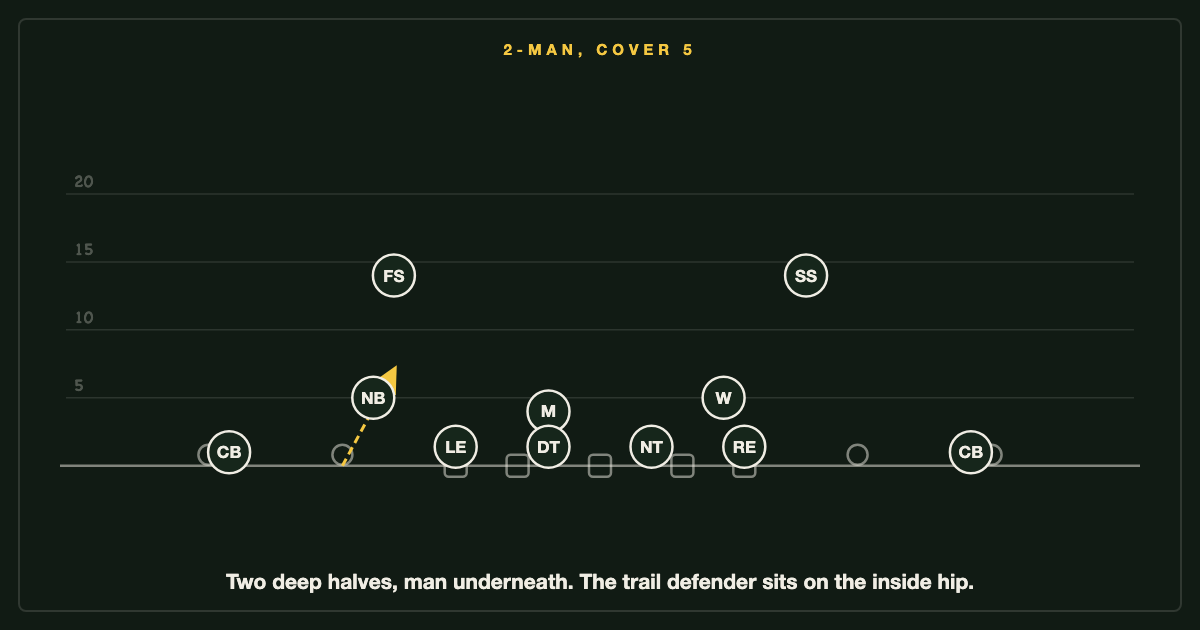
The E24 cheat card teaches 2-Man as man coverage underneath with two deep half safeties over the top. Correct, and it is why nothing gets behind it.
What the card cannot show you is the technique the underneath defenders are using, and that technique is the reason your receiver looked open right up until the ball got there.
Why the safeties change what the corners can do
Bowen's definition is a two deep, man under defense with trail man coverage underneath and the protection of two deep half safeties over the top. Saban's tree numbers it Cover 5, which is where the app's identifier comes from.
The safeties align on the same landmarks they would use in pure Cover 2 and gain depth at the snap. Underneath, defenders play press or off man with inside leverage.
Here is the part that matters. Because there is help above and behind, the underneath defenders can play far more aggressively than a man defender normally dares. Saban's word for it is Dog, and his clarification is worth quoting exactly: Dog means play aggressive, not let your man get behind you.
Trail technique, the defining detail
The underneath defender sits low to the receiver's inside hip and trails him, playing with his back turned to the line of scrimmage.
Every instinct says that is wrong. A defender who cannot see the ball cannot play the ball. That is exactly the trade. He is not trying to play the ball. He is trying to be attached to the receiver's inside hip at the break point, and the safety above him is responsible for anything thrown over the top.
What it eliminates is the entire inside breaking family. Slants, digs, posts, smash concepts. The defender is already sitting where those routes want to go, and he arrives at the break rather than chasing it.
Against a tight end running a seam, a linebacker applies the same idea by walling him off, preventing the route from stemming back toward the near hash.
What that does to your timing
Your read is not wrong. Your receiver genuinely is open, in the sense that no defender is in front of him.
The defender is behind and inside, running with him, waiting for the ball to commit. That is the mechanism behind completions that go nowhere and collisions at the catch point. Describing it as a coverage that concedes the throw and attacks the reception is our summary of the technique rather than language the sources use.
Calling it a yards after catch defense is our reading rather than a sourced label. It follows from the technique though: a trail defender on the inside hip is placed to arrive at the reception, not to break up the throw.
Nobody can tell you where it came from
Worth stating plainly, because every other coverage in this series has an origin section and this one does not.
No source found in the research dates or attributes 2-Man. It sits in the literature the way Cover 0 does, treated as a primitive that man coverage arrives at rather than something a person invented on a particular afternoon. Saban's tree numbers it Cover 5, which is where the identifier in Defense IQ comes from, and his is the best documented rule set for it.
That is a gap in the record, not a fact about the coverage. If somebody produces the origin, it belongs here.
Rubs, and the thing trail technique cannot solve
An article about man under coverage that never mentions rubs is incomplete on its own terms, so here it is.
Trail technique attaches a defender to a receiver's inside hip and asks him to stay there. That instruction has one obvious counter: put a body in the way. Pick and rub concepts, mesh, stacks and bunches all work by making the defender run into traffic he cannot legally be blocked into but also cannot avoid.
The published weaknesses point the same direction. Inside seams and four verticals stress the safeties. Fades with vertical stems attack the safety who leaned inside. Sail concepts stretch the coverage horizontally at two depths at once.
And because every underneath defender is locked to a receiver, nobody is looking at the quarterback. A scrambling quarterback runs a long way against this coverage, and the corners with their backs turned are the reason.
Two variants worth recognizing
5 Cougar. If the second receiver goes out inside the first five yards, the apex defender calls it out and the corner takes him, while the apex cuts the outside receiver's route. That is Palms and Cloud thinking folded into a man coverage, and it means an early out route can change who has you.
55. Double bracket. Each safety brackets the most dangerous receiver to his side, chosen by game plan, and that receiver can be a wide out, a tight end or a back.
One more label to know, because broadcasts use it constantly: Cover 2 Man is the same coverage.
Where it leaks
Catch it short and run it long. That is the summary, and it follows directly from the structure.
Underneath defenders are trailing from the inside hip with their backs turned, which means they are poorly placed to make a play on a ball thrown in front of the receiver and away from that hip. Quick outs, hitches, anything that breaks off before the trail defender can attach.
The second leak is the number of bodies. Two safeties deep and man coverage underneath uses a lot of defenders on receivers, which means fewer of them are looking at the run and fewer are available to rush.
What to do with this on Saturday
The E24 drill still stands. Two deep safeties with defenders turning and running underneath is 2-Man, and deep shots are not the answer.
This is the next rung:
Assume your open receiver has company you cannot see. A trailing defender on the inside hip does not appear in your read the way a defender in front does. He shows up when the ball does.
Throw in front and away from the inside hip. The technique is built to take the inside. The out breaking route and the ball placed to the outside shoulder is the throw the defender is least able to contest.
Break it off early. The trail man wants to attach at the top of the stem. A route that never gets to the top of the stem never gives him the chance.
Count the rush. A coverage that spends this many defenders on receivers usually is not sending many, which means the answer might be time rather than any particular route.
2-Man does not try to stop the pass. It tries to make sure the pass is all you get.
The E24 cheat card gets you seeing two deep and man under. This gets you seeing the trail. Drill both in Defense IQ until the read arrives before the thought does.
The lesson this goes with: E24, E56 in the Film Room, where the free cheat card lives.
Where this comes from
Every claim above is checkable. These are the published sources behind it, and where they disagree the article says so.