Cover 2 Explained: The Hole Pittsburgh Left Open in 1973
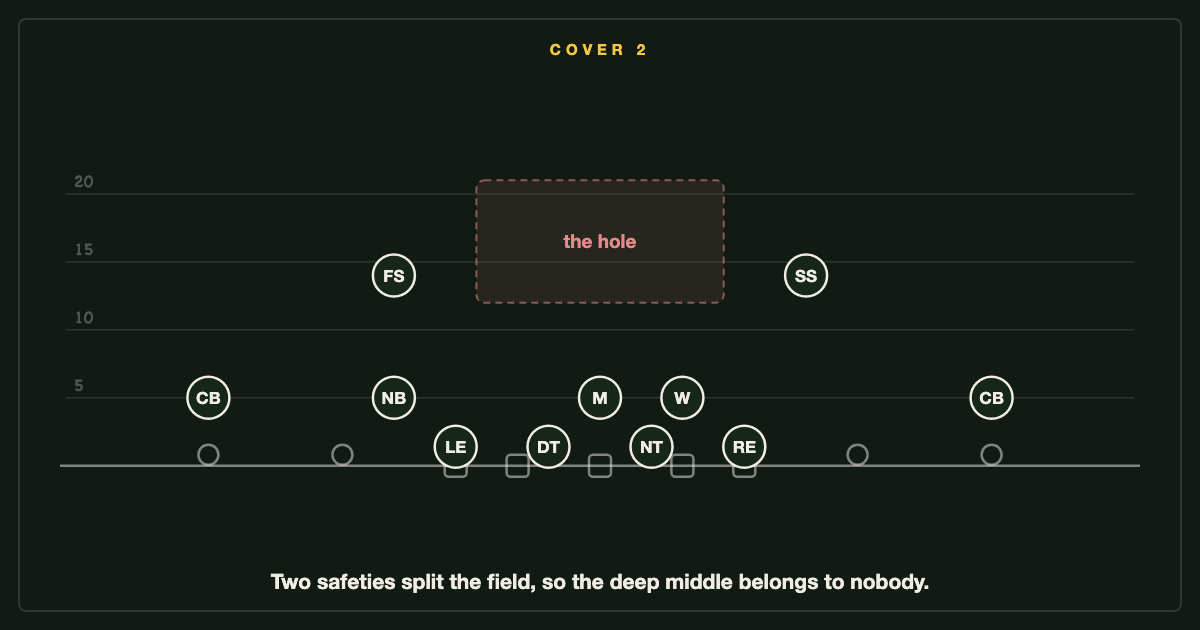
The E02 cheat card teaches Cover 2 as two deep safeties over five underneath defenders. That picture has been accurate since 1973.
The reason it is worth a longer look is that this coverage has a known, permanent, structural weakness that every coach in football can point to, and half a century of adjustments have not closed it. They have only made it more expensive to reach.
Where it came from, on the record
This is the best documented origin in the series, because the man who carried the lineage put it in writing.
Tony Dungy, in his own words: Cover 2 was introduced to the NFL by Bud Carson and the Pittsburgh Steelers in 1973. Dungy adds that he took the Tampa version right out of the Steeler playbook.
Carson began developing it at Georgia Tech, was hired by Chuck Noll as the Steelers defensive backs coach in 1972, and became defensive coordinator in 1973. Dungy played under him in Pittsburgh from 1974 to 1977 and later installed his own version with Monte Kiffin at Tampa Bay.
The detail that matters most: in the 1970s, Carson addressed the coverage's weakness by having middle linebacker Jack Lambert drop back like a third safety on pass plays. That is the direct ancestor of Tampa 2, and it means the fix is as old as the problem.
The structure, with real numbers
Bowen calls it a two deep, five under zone run out of both base and sub package personnel.
The safeties split the field with the top of the numbers as their landmark. Bowen has them aligning at fifteen yards and working to eighteen at the snap. Weekly Spiral gives a twelve to eighteen band. Corners play press or head up on the outside receiver, sitting around five to six yards in the squat version. The Sam and Will sink to ten to twelve yards between the numbers and the hashes, and the Mike works the inside vertical seam with his head on a swivel.
The ten to twelve yard underneath band and the top of the numbers landmark are both corroborated across sources, which makes them safe to memorize.
The hole everybody knows about
Two safeties splitting the field means neither one owns the middle of it. The deep middle is not assigned to anybody, and the seam between them is some of the softest ground on the field.
That is the structural problem, and it cannot be solved without changing the coverage into something else. Which is exactly what Carson did with Lambert and what Tampa Bay later formalized.
The second soft spot is the sideline behind a squatting corner. A corner playing at five to six yards with his eyes in the backfield is not running with anybody deep, and the space over his head belongs to a safety who is starting from the top of the numbers on the other side of the hash.
Those two answers, the seam and the deep sideline, are the same answer stated twice: two deep defenders cannot cover the width of a football field at depth.
How coordinators made the hole expensive
The hole never closed. What changed is what it costs to reach it.
The first answer was Jack Lambert, and it became Tampa 2: send the middle linebacker to the deep middle and accept one fewer underneath defender. That fix is more than fifty years old and it is still the main one.
The second answer is the corner. A squat corner who jams and re-routes the outside receiver disrupts the timing that vertical concepts depend on, which buys the safety the extra beat he needs to cover ground he cannot otherwise cover.
The third is disguise. Cover 2 and 2-Man show the identical two high shell before the snap, and so does the Robber look that resolves late. The picture stopped being a promise a long time ago.
Two variants wearing Cover 2's clothes
Cover 2 Invert. The safeties and underneath defenders swap the usual responsibilities, which changes who is deep and who is squatting without changing the pre-snap picture at all.
2-Trap. The corner sits on the quick out and drives it while the safety takes the deep responsibility over the top of him. If you have completed the same quick throw twice, the third one is the one that gets driven.
Both matter for the same reason: the two high shell tells you how many deep defenders there are, and almost nothing about what they intend to do.
Why coaches keep calling it anyway
Because what it gives you underneath is real. Five defenders in the short zones with vision on the quarterback is a hard picture to complete easy throws against, and the squatting corners take away the quick outside game that most offenses lean on when they are behind schedule.
It is also honest about what it concedes. A coordinator calling Cover 2 has decided the deep middle is a price worth paying to make the short and intermediate game difficult. On second and long that is often correct.
What to do with this on Saturday
The E02 drill still stands. Two safeties at depth, corners squatting, and the middle of the field is open.
This is the next rung:
Look at the middle first, not last. The hole is structural, not situational. It is there on every snap of true Cover 2, and it has been there since 1973.
Check whether the Mike is dropping. If he keeps going and gets to real depth, you are not in Cover 2 anymore, you are in Tampa 2, and the hole you were about to throw into just grew a linebacker.
Attack the corner's conflict. He is squatting with his eyes inside. A route that starts like the quick throw he is squatting on and keeps going is the corner route, and it lives behind him.
Count the underneath defenders. Five short zone players is a lot of coverage in a small area. If the short stuff is not there, that is the coverage working, not you failing.
The E02 cheat card gets you seeing two deep and five under. This gets you seeing the fifty year old hole and the fifty year old fix. Drill both in Defense IQ until the read arrives before the thought does.
The lesson this goes with: E02, E09 in the Film Room, where the free cheat card lives.
Where this comes from
Every claim above is checkable. These are the published sources behind it, and where they disagree the article says so.