Cover 6 Explained: Quarter, Quarter, Half, and Who Argues
The E18 cheat card teaches Cover 6 as quarter, quarter, half. Half the field plays Quarters, the other half plays Cover 2, and four plus two is six.
The picture is right. What is genuinely unsettled, across serious coaching sources, is which half of the field gets which coverage. Three different answers are in print, all of them defensible, and knowing that is worth more than memorizing one.
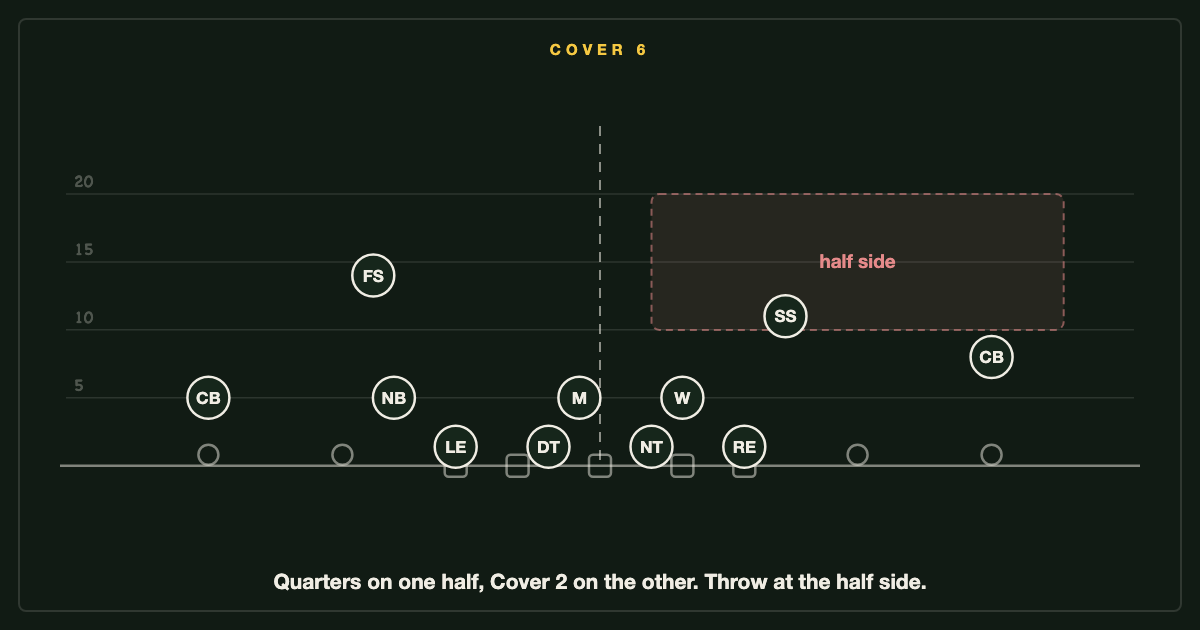
The split, and what each side is doing
On the Cover 2 side, the corner funnels the outside receiver inside and sinks to the flat with vision in the backfield. The safety covers the deep half, splitting the difference between vertical routes. The linebacker funnels the second receiver outside and sinks to the seam or hook at ten to twelve yards.
On the Quarters side, you get the match rules described in the Cover 4 article: defenders reading the second receiver and passing off responsibility based on what he does.
So one half of the field is playing spot zone with a squatting corner, and the other half is running if then rules off a receiver. Same snap. Same defense.
The three competing rules, all of them real
Published coaching sources disagree here more than anywhere else in the coverage vocabulary, and all three positions below come from credible ones.
Field and boundary, which is the most common teaching. Quarters goes to the field, meaning the wide side, and Cover 2 goes to the boundary, the short side. The logic is workload. When the ball is on a hash, the safety who has to cover a half alone gets the narrower boundary side, and the safety and corner pair together take the wider field side, so nobody is asked to cover too much ground.
Passing strength, which is the Fangio approach. Quarters goes to the passing strength and halves away from it, building a box coverage toward the strength and creating a zone double on the offense's best receiver. In this framework Cover 8 is the flip of it, putting Cover 2 to the passing strength.
Saban's tree, where Cover 6 is not quarter quarter half at all. In that system it is a single high coverage, and it means the safety rotates down away from the passing strength.
Defense IQ uses the first position, field and boundary, because it is the most common and the most teachable. That is a choice, and it is better to say so than to let you think the term is settled.
Why the split exists at all
Because the two halves of a football field are not the same size once the ball is on a hash, and because your best receiver is usually on one side rather than both.
A defense that plays one coverage across the whole field is answering two different questions with one answer. Cover 6 refuses to do that. It matches the coverage to the problem on each side, which is why it shows up so often against formations that are lopsided.
The cost is complexity and a seam in the middle where two different sets of rules meet.
What is actually visible before the snap
The closer below tells you to identify which side is which, so here is what to look at.
Safety depth and spacing. The Cover 2 side safety plays a deep half alone, so he sits deeper and works toward the top of the numbers on his side. The Quarters side safety works from ten to twelve yards with a corner sharing the deep responsibility beside him, so he can afford to be shallower and closer to the second receiver.
Corner depth and eyes. The Cover 2 side corner sits shorter and funnels the outside receiver inside with vision in the backfield. The Quarters side corner plays off with his eyes on the second receiver, because his assignment depends on what that receiver does.
The linebacker. On the Cover 2 side he funnels the second receiver outside and sinks to the seam at ten to twelve yards. On the Quarters side he is re-routing inside and dropping to the curl flat.
One caution. Against trips, all of this gets renegotiated, and three by one is where Cover 6 actually lives in modern football. A trips set forces the defense to declare, and the declaration is worth more information than any static picture.
Where to throw
Find the Cover 2 half. That is where the honey hole lives, the same soft spot described in the Cover 2 article: behind the squatting corner and in front of the deep half safety.
The corner route is the classic answer for exactly that reason. It works away from the quarters side, where the match rules and the extra deep defender are, and into the half of the field that is playing a coverage with a known and permanent hole.
The other answer is the seam where the two coverages meet. Two different rule sets have to communicate in the middle of the field, and communication is a thing that fails.
What to do with this on Saturday
The E18 drill still stands. Count the safeties, notice they are doing different jobs, name it quarter quarter half.
This is the next rung:
Identify which side is which before you pick a read. One safety is deep over a half. The other is one of a pair over quarters. They are standing at different depths doing different jobs, and that is visible.
Throw at the Cover 2 half. That side has the older, better documented weakness, and your corner route lives there.
Do not assume the rule. Field and boundary is the most common teaching, not a law. If the quarters side keeps showing up on the strength instead of the field, you are facing a different framework and your pre-snap shortcut just became a liability.
Attack the seam between the systems. Where two coverages meet somebody has to make a call. No source we found names this as a designed weakness, so treat it as reasoning rather than doctrine.
The E18 cheat card gets you seeing the split. This gets you seeing which half to attack and why coaches argue about the other one. Drill both in Defense IQ until the read arrives before the thought does.
The lesson this goes with: E18 in the Film Room, where the free cheat card lives.
Where this comes from
Every claim above is checkable. These are the published sources behind it, and where they disagree the article says so.