Zone Blitz Explained: LeBeau's Fire Zone and Its Rules
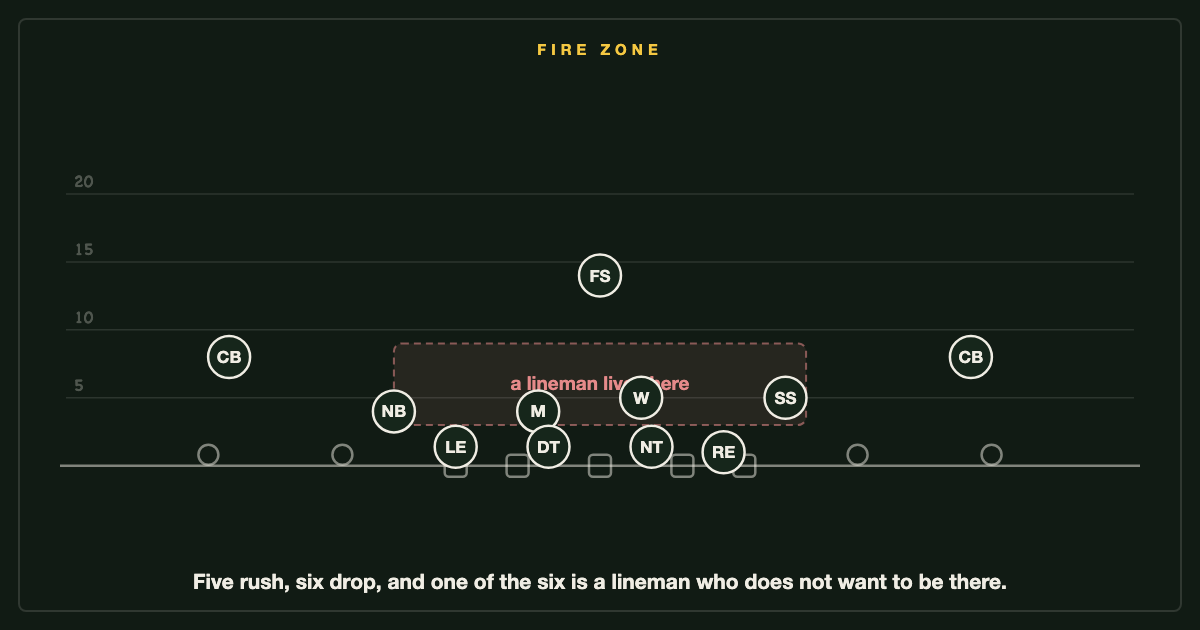
The E25 cheat card teaches the Fire Zone as a five man pressure with six dropping into coverage, three deep and three under. That is the structure.
The intent is more useful than the structure. The man who built it said quarterbacks told him they no longer knew who to read, and that this was precisely the point of it all. Everything strange about the look is in service of that one goal.
Where it came from
Dick LeBeau, with the Cincinnati Bengals in the mid 1980s. He began working on a way to pressure the quarterback without sacrificing coverage in 1984, preparing for his first coordinator job.
The seed was a conversation. While scouting the 1984 draft, LeBeau talked with LSU coach Bill Arnsparger about how to bring the blitz while still covering receivers adequately.
What came out of it sends defenders from unexpected places while dropping a defensive lineman into the zone that a safety, corner or linebacker just vacated. It was a response to the pass happy West Coast offense, and the confusion it created helped Cincinnati reach the Super Bowl after the 1988 season, losing 20 to 16 to San Francisco.
One honesty note worth saying plainly: LeBeau is best known as the primary evangelist of the zone blitz rather than its sole inventor, and Dom Capers is credited alongside him for modernizing NFL defense with it.
Five rush, six drop, and one of them is a lineman
The count is the easy part. Five rushers, six in coverage, three deep and three under.
The two rules that make it a Fire Zone rather than an ordinary blitz are that at least one rusher comes from a non obvious place, and at least one defensive lineman drops into coverage.
That second rule is doing more work than it looks. A three hundred pound lineman dropping into a hook zone is not there because he covers well. He is there because his departure from the rush means somebody else's arrival is unaccounted for, and because your protection rules were written assuming linemen rush.
The coverage behind it is a matchup scheme
This is where most explanations stop and where the interesting part starts.
The three under defenders are not sitting in fixed zones. It works like a matchup zone in basketball, with defenders passing off receivers to match the first, second and third receivers, counted from the outside in, based on the route concept.
The drops have names and rules. The Seam player drops over the second receiver, and LeBeau's own definition of his job is outside in technique on number two, must carry vertically or to the flat.
So the picture is a blitz, and the coverage behind it is more organized than a blitz normally allows. That combination is the entire invention.
What it gives up
Three deep and three under is one fewer underneath defender than a standard three deep four under structure, and the underneath players are matching rather than sitting, which means there are moments during the pass off where a receiver belongs to nobody.
The dropping lineman is the other cost. He is in a coverage role he does not play often, against athletes who do, and anything thrown at the zone he inherited is thrown at the weakest coverage defender on the field.
The hot answer is the standard one and it is standard for a reason. Five rushers against five blockers with an unaccounted rusher means somebody is free, and the throw that beats a free rusher is the one that leaves before he arrives.
What to do with this on Saturday
The E25 drill still stands. Five coming, six dropping, get it out.
This is the next rung:
Find the lineman who is not rushing. He is standing in a zone somebody else used to own, and he plays coverage far less often than anyone near him. That he is the softest defender out there is an inference rather than a sourced claim, but it is the one most offenses act on.
Do not read the pre snap picture as the rush. The whole design is that the man who looks like a rusher drops and the man who looks like a dropper rushes. Counting bodies at the line will lie to you.
Know your hot read before the snap. Not after. The pressure is designed to arrive before a post snap decision can be made.
Attack the pass off. Matching defenders have to hand receivers to each other. Crossing routes and concepts that change who is who during the play make that handoff happen at speed.
The Fire Zone is not chaos. It is an orderly coverage wearing a chaotic costume, and the costume is the product.
The E25 cheat card gets you seeing five and six. This gets you seeing which six, and which one of them does not want to be there. Drill both in Defense IQ until the read arrives before the thought does.
The lesson this goes with: E25 in the Film Room, where the free cheat card lives.
Where this comes from
Every claim above is checkable. These are the published sources behind it, and where they disagree the article says so.