Reading the Defense Before the Ball Moves: A Checklist, Not a Promise
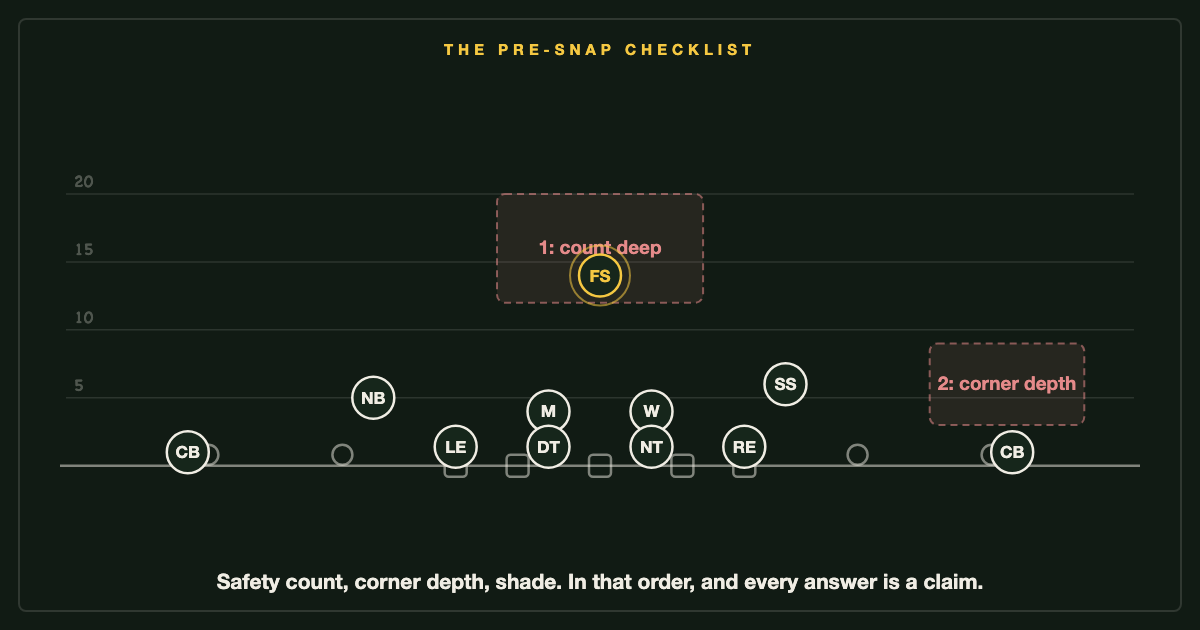
Every rep in Defense IQ starts from a frozen picture. Before the snap, a real defense hands you the same thing, and there is a taught order for reading it.
There is also a rule that has to sit on top of the whole checklist. A pre-snap look is a claim the defense is making, and defenses lie for a living. Read the picture in the right order, then treat every answer as something to verify, not something to bank.
The framing that has to come first
A static defensive picture does not tell you what is about to happen. It tells you two things: which threat the defense has spent its bodies on, and therefore which answer the offense should choose.
Every serious coaching source frames it that way. The box count is taught as the offense's decision input, run it or get out of it, never as a prediction. The same picture that invites a run does not promise the defense will stop one. So the question you are really answering before the snap is not what is coming. It is what is this defense inviting, and the whole checklist below serves that question.
That framing is also why the checklist survives disguise. A claim you set out to verify can be caught lying. A claim you treat as truth cannot.
Count the safeties first
The safety count is the highest-value single read on the field, and it splits the world in half.
One deep safety, middle of the field closed, means the seventh run fitter is already in or near the box. The coverage world narrows to Cover 1 or Cover 3, and the run math tilts toward the defense. Two deep safeties, middle open, means a lighter box and a numbers lean toward the run for the offense, with a coverage menu that includes Cover 2, Quarters, Cover 6, 2-Man and their disguised cousins. No safety deep at all is its own announcement.
Depth refines the count. A safety inside about ten yards is functionally a run-fit player. A safety at twelve or deeper is a pass player. That threshold is a synthesis of the published depth tables rather than a quoted law, but the tables converge on it: run-support alignments cluster at eight to ten, Cover 1 free safeties at twelve to fifteen, Cover 2 halves at fifteen working to eighteen.
Corner depth and posture, the leaning tells
Corners within six yards is most likely some type of man coverage. That comes from a quarterback coverage-recognition deck that exists as one document on two hosts, so treat it as one source, a lean rather than a law. Pressed at the line means man or a Cloud corner squatting for the flat. Seven to eight yards off is the standard alignment for Cover 1, Cover 3 and Cover 4 alike, which is exactly why depth alone cannot separate those three.
Linebacker depth leans the same way. Backers at four yards are downhill players, blitz or run fit. Backers at seven are reading pass first, building a head start on their drops. One QB-teaching source states that contrast directly; treat it as a heuristic.
And the caveat that keeps all of this honest: zones bluff press, man plays off, and Seattle built a dynasty on corners who pressed and then bailed into thirds. Depth and posture are leans. They buy you a hypothesis, not a conclusion.
Leverage, the cleanest tell on the field
One pre-snap detail separates two coverages all by itself, and it is the shoulder the defender stands on.
In Cover 1 pressure, defenders align with an outside shade and funnel routes to the free safety in the middle. In Cover 0 pressure, defenders play from an inside shade with no middle help at all, and the coaching answer to where is your help is the sideline. Two press pictures that look identical, one difference, and the answer flips between man free and zero.
That pair is corroborated across a seven-year NFL defensive back and an independent coaching glossary, and it is the cleanest man-coverage discriminator in the published record. The leverage article takes the idea the rest of the way: the shade plus the location of help predicts which route family is open.
The published checklists, so you are not inventing one
Joe Moorhead teaches a four-point pre-snap order. Shell: one deep safety or two, a baseline that does not guarantee the post-snap structure, his caveat and not ours. Eyes: do the backs and backers show man eyes or zone eyes, the place he says defenses work hardest to deceive, with the nickel named as the most reliable indicator when other reads blur. Front structure: how many down linemen and where, because how the front is built tells you how the second level fits behind it. Then depth, leverage, tilt and skew of the backers and safeties.
He adds the String Principle: every second and third level defender is tied to a string, so one man creeping is not one man moving, it is a coordinated rotation announcing itself early. The rotation article is about what happens when they wait until the snap to pull the string.
The other published frame is Box D.E.A.: box count, depth of the corners, eyes of the defensive backs, alignment. Same skeleton, same warning attached, the picture may change after the snap.
Both checklists agree on the deep truth. Order matters, eyes outrank depth, and nothing pre-snap is final. The reasons it cannot be final have their own article.
What to do with this on Saturday
The cheat cards drill single reads. This is how they chain:
Safeties first, always. Count them, then check their depth. That one read splits the coverage menu in half and prices the run at the same time.
Then corners: depth, posture, shade. Inside six leans man. Press leans man or Cloud. The shade is the sharpest edge, inside shade with an empty middle is zero, outside shade with a middle safety is man free.
Then the second level. Backer depth for run or pass intent, and one man creeping means the string is being pulled everywhere.
Say the word claim to yourself. Whatever the picture told you, the first steps after the snap either confirm it or replace it. A read you refuse to update is worse than no read at all.
The picture before the snap is the defense's opening statement. It is evidence, and it is allowed to be false.
The cheat cards get you naming each piece. This gets you reading them in order and holding them loosely. Drill it in Defense IQ until the read arrives before the thought does.
The reps that build this read live in the Film Room, where the free cheat cards live.
Where this comes from
Every claim above is checkable. These are the published sources behind it, and where they disagree the article says so.