Disguise Economics: Only Some Coverages Draw Their Own Picture
Count the pre-snap pictures a defense can show you: two safeties deep, one safety deep, nobody deep. Now count the coverages in Defense IQ. The second number is much bigger than the first.
That mismatch is not trivia. It is the entire economics of disguise. When many coverages share a few pictures, most coverages are wearing a borrowed look on any given snap, and the borrowing is not occasional deception. It is the normal condition of the sport.
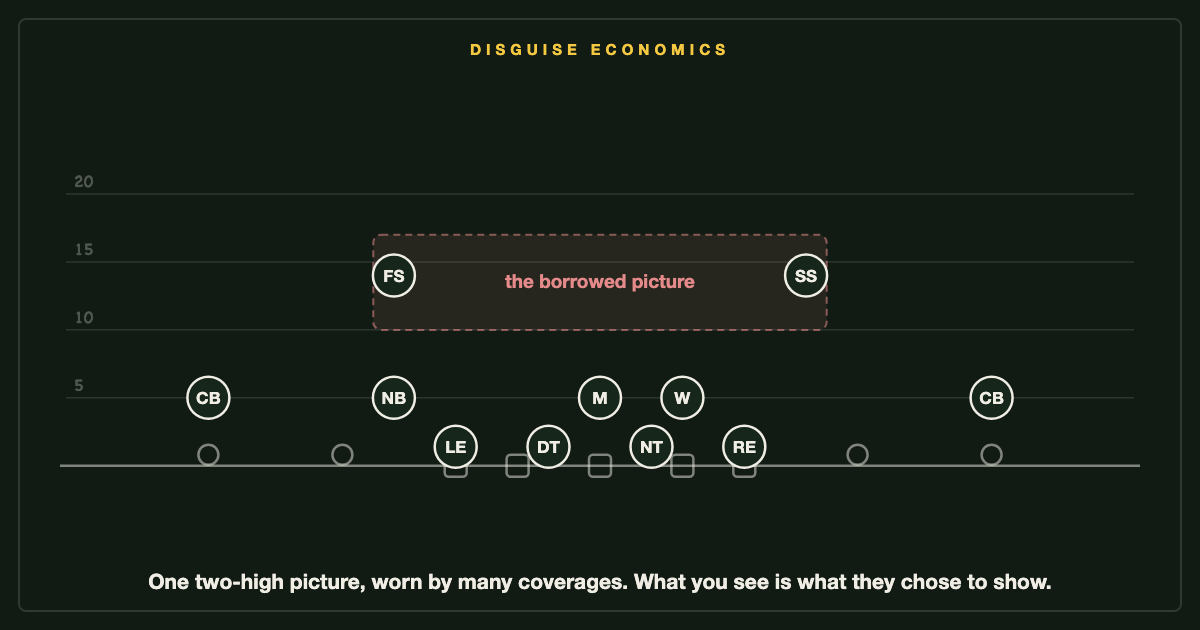
Three shells, many tenants
The pre-snap shell is a photograph of the safeties, and there are only a few poses. Middle of the field open, two deep. Middle closed, one deep. And nobody deep at all.
Now look at who lives behind the two-high picture alone. The published list, corroborated: Cover 2, Cover 4, Cover 6, 2-Man, Palms, and a disguised Cover 1 Robber that is not a two-high coverage at all. Six different sets of rules, one photograph.
The single-high picture is less crowded but still shared: it narrows the world to Cover 1 or Cover 3, which still leaves man against zone unresolved, and leaves the match-versus-spot-drop question invisible entirely. The shell is a filter, never an answer.
The borrowers
Some coverages do not merely share a picture. They are built specifically to wear somebody else's.
Tampa 2 and Cover 2 are the same picture before the snap; the only difference is the Mike's depth after it. 2-Man and Cover 2 show the same shell, with every difference buried in the underneath players' leverage and eyes. Cover 3 Buzz presents a two-deep look and becomes single-high when the safety sinks. Robber is listed by Bowen as a counter call precisely because it resolves late out of a two-high shell.
The purest case is trap coverage. 2-Trap looks like Cover 2 before the snap because that is the bait: it exists to rob offenses that installed Cover 2 beaters, and the corner's soft squat only springs when the quick out shows. The borrowed picture is not camouflage on top of the coverage. It is a load-bearing part of the coverage, and Palms runs the same con from the Quarters shell.
Even the underlying shells lie about themselves. The Cover 2 safety can play tighter on the hash before widening, which one source names as a disguise tool in its own right. The photograph is retouched before you ever see it.
The few that must show you their hand
A small number of coverages have a picture that is close to theirs alone, and it is worth noticing why.
Cover 0 is the clear case. To send everybody, the defense must eventually empty the deep middle, and an empty deep middle with inside shades across the board is a picture no other coverage wants to wear. The Cover 0 article calls the look the receipt: if the defense wants you throwing hot right now, it has to show you this. The coverage's job and its picture are the same object.
Even there the honesty arrives late. The published disguise note on Cover 0 is that safeties often line up deep and rotate into their man assignments late, so the receipt is shown as close to the snap as the defense can manage. The coverages that must author their own picture author it at the last legal moment.
The general shape is this: a coverage pays for a unique picture only when the picture itself does work, the way zero's empty middle forces hot rules and protection checks. Everything else borrows, because borrowing is free and honesty is expensive. How many of the taught coverages fall on each side of that line is a count we have not verified, so no number ships here. The asymmetry itself is the fact.
Why this makes the read a claim
Put the economics together and the reading doctrine falls out by itself.
Moorhead's own caveat on the shell read is that it establishes a baseline and does not guarantee the post-snap structure. The rotation literature explains the mechanism: the defense can convert the shown shell into the real one at the millisecond of the snap, and modern movement is explicitly designed to keep quarterbacks blind to the rush and the coverage. The rotation article covers the moving half of that story.
So the pre-snap read is a claim for a structural reason, not a motivational one. A picture shared by six coverages cannot logically tell you which of the six you face. The information you need is rationed by design: some of it is in the shell, some in eyes and leverage, and the remainder is only released after the snap, in the safeties' first steps and in what the seam players do with a vertical release.
The practical posture follows: collect the free information before the snap, hold it as a hypothesis, and spend your first post-snap look confirming or replacing it. That is the whole method of the pre-snap article, and this article is the reason the method is shaped that way.
What to do with this on Saturday
The cheat cards teach you coverages one at a time. This is the lens that holds them together:
Learn coverages in shell families, not alphabetically. Group everything that wears the two-high picture and drill the differences between them, because that group is what an actual snap asks you to separate.
Treat a unique picture as expensive information. When a defense shows you something only one coverage wears, an empty deep middle above all, it paid for that honesty and it wants something in return. Usually your hurry.
Assume the borrowed look until proven otherwise. Two-high before the snap is the most shared costume in football. Let the safeties' first steps, not the photograph, tell you who was really under it.
Remember the traps are picture-first. 2-Trap and Palms work because the picture told you a true-looking lie. The quick throw you have completed twice is the one the borrowed look was saving up for.
Few pictures, many coverages. That one asymmetry explains most of what makes reading defenses hard, and all of what makes it a skill.
Defense IQ drills the separations inside each shell family. Drill them until the read arrives before the thought does.
The reps that build this read live in the Film Room, where the free cheat cards live.
Where this comes from
Every claim above is checkable. These are the published sources behind it, and where they disagree the article says so.