Strength and Numbers: How Defenses Set the Front
Defense IQ teaches you to count the box. Underneath that count is a whole arithmetic both sidelines are running on every snap, and it starts with one declared word: strength.
The front does not just line up. It is set, to a side, by a rule, and which rule a defense uses changes what motion does, what the count means, and where the soft gap sits. None of it is guesswork. All of it is counting.
Strength is a decision, not a fact
Ask three coaches what the strong side is and you can get three answers, all real, all in print.
Passing strength: the side with the most eligible receivers, the three-receiver side of a 3x1. Fangio's defense sets its secondary this way, to the side with more or better receiving threats. Field strength: the wide side of the field, set by where the ball sits on the hash, regardless of formation. Formation strength: set to the tight end, which means a formation can put run strength one way and pass strength the other on the same snap.
One youth-level source enumerates eight named strength calls, to the field, the boundary, the tight end, away from him, the passing strength, away from it, to the back, away from the back. That list is single-sourced and flagged as such, but the point it makes is corroborated everywhere: strength is declared, not discovered. And the base structural rule that follows the declaration is corroborated twice over: 3-technique to the strength, 1-technique weak.
Why you care: the Cover 6 article shows serious systems disagreeing about which side of the field gets which coverage, and this is the same argument. Field-and-boundary systems and passing-strength systems are answering different questions with the same eleven men.
The count, and the gap math under it
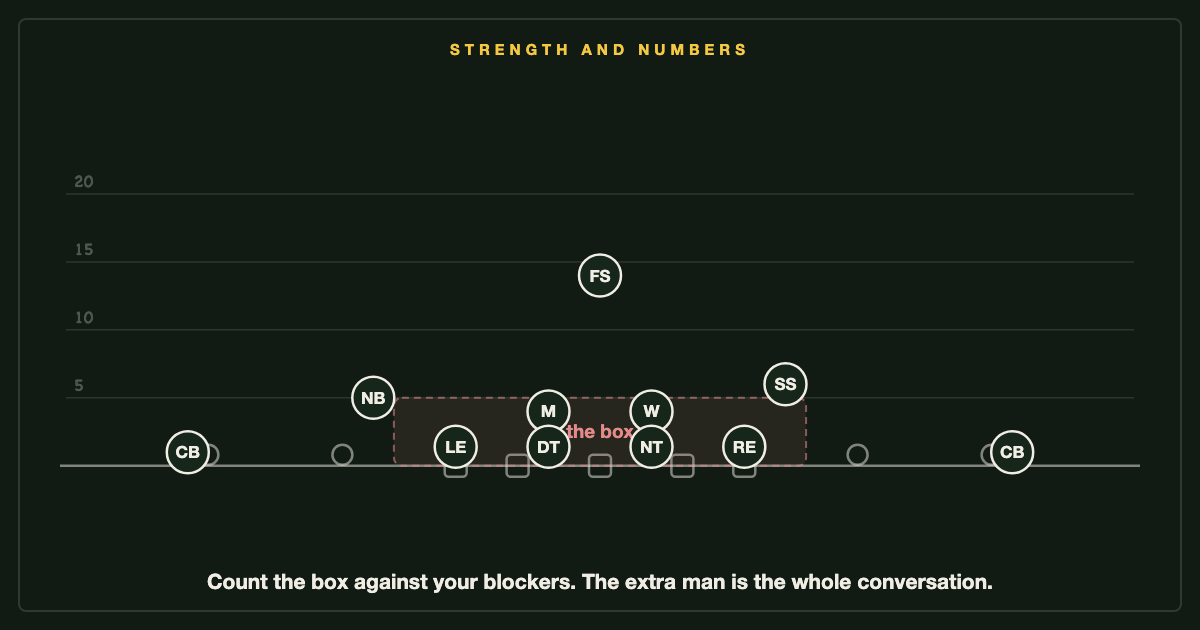
The box count is the offense's tool for deciding whether it has a numbers advantage in the run game. The corroborated thresholds: six or fewer in the box is light, run it. Seven is balanced, decide on leverage. Eight or more is heavy, get out of the run.
The caveat that must travel with those numbers: they are relative to how many blockers the offense has, not absolute. The real rule underneath is gap math. The defense needs as many run-fit defenders as the offense presents gaps, and every additional blocker adds a gap that demands another defender. One source states it from ten personnel, six gaps needing six fitters. Another states it as six blockers meaning seven gaps and seven box players to be sound. The principle is corroborated; the exact personnel-to-gap tables differ by source, and that variance is recorded rather than smoothed over.
Who counts: down linemen always, second-level players within about seven yards of the line, safeties only when walked down. A defender deeper than about eight yards is a deep defender, not a box defender. Corners never count.
The bubble: the count tells you whether, the front tells you where
Counting hats answers whether to run. The front answers where. The bubble is the area around an uncovered offensive lineman, and it is where the offense has the best leverage to run the ball. In a traditional Over front, the bubble sits away from the tight end.
Even and odd spacing are defined by which gap is left open: even spacing leaves the B gap, odd spacing pushes the open gap out to the C. So a drawn front is a map with one soft spot marked on it, if you know to look for the uncovered man.
Put together, the teachable sentence is: count the box, then find the bubble. The count tells you whether to run, the bubble tells you where. That synthesis is ours, assembled from the sourced pieces above, and it is the cleanest one-line summary of the whole run-game exchange.
Why offenses motion: to flip the count
Motion is arithmetic warfare. A receiver crossing the formation changes which side has more bodies, and what the defense does about it depends entirely on which strength rule it lives by.
In a passing-strength system, the nickel travels with the crossing receiver and the coverage flips. The published Cover 8 example walks it through: a receiver moves from the strength to the weak side, the nickel follows, and the defense now plays its halves coverage to the new passing strength and quarters to the other side. In a field-and-boundary system, motion typically produces no coverage adjustment at all, because the strength was set by the hash, and the hash did not move.
That distinction also patches the most common motion myth. A defender traveling with motion is the classic man tell, and it is a good one, but a zone defense that sets by passing strength also travels its nickel. Travel means man or a strength-set zone flipping its call. The bump-versus-travel test, and its one false positive, get full treatment in the man-or-zone article.
One more than they can block
The whole exchange terminates in a single idea: somebody is trying to be plus-one.
The defense's version is the overload, blitzes built to bring one more than the protection can handle, aimed at the count the offense declared with the Mike point. The maximum version is 9-man spacing, every gap assigned vertically, with Cover 0 behind it because there is nobody left to be behind it.
The offense's version is the RPO numbers rule: throw if you have the numbers advantage, run if you do not. If the defense is plus-one in the box, the offense relies on leverage to attack space in the pass game instead. One source is honest about the limit, and the honesty is worth quoting: without multiple options, sometimes you have to just line up and run into an outnumbered box.
Notice what none of this involves: predicting the play. The count is an invitation, and both sides read it as one. That framing rule runs through the pre-snap article and it governs here too.
What to do with this on Saturday
The cheat cards drill the box count. This is the arithmetic around it:
Count hats against gaps, not just hats. Six in the box means nothing until you know how many gaps the formation presents. The thresholds are shortcuts for the gap math, not replacements for it.
Find the declared strength. 3-technique to one side is the front telling you which side it respects. If that side is set to the field instead of the receivers, you just learned which rulebook the defense uses.
Find the bubble. The uncovered lineman marks the soft gap. Count tells you whether, bubble tells you where.
Use motion as a question. The defense's answer, travel, bump or nothing, tells you its strength rule and leans its coverage, two answers for the price of one shift.
Strength and numbers is the game before the game, and it is all counting.
Defense IQ drills the box read. Drill it until the count arrives before the thought does.
The reps that build this read live in the Film Room, where the free cheat cards live.
Where this comes from
Every claim above is checkable. These are the published sources behind it, and where they disagree the article says so.