Pattern Matching: The Zone That Turns Into Man
Defense IQ teaches you to sort coverages into man and zone. Pattern match is the family that answers both, in that order, on every snap.
It starts as zone, watches your receivers distribute, and converts to man on whoever ends up in each defender's world. The conversion runs on two written triggers, it was invented on a specific team in a specific year, and the reason it exists is a play you have probably called a hundred times.
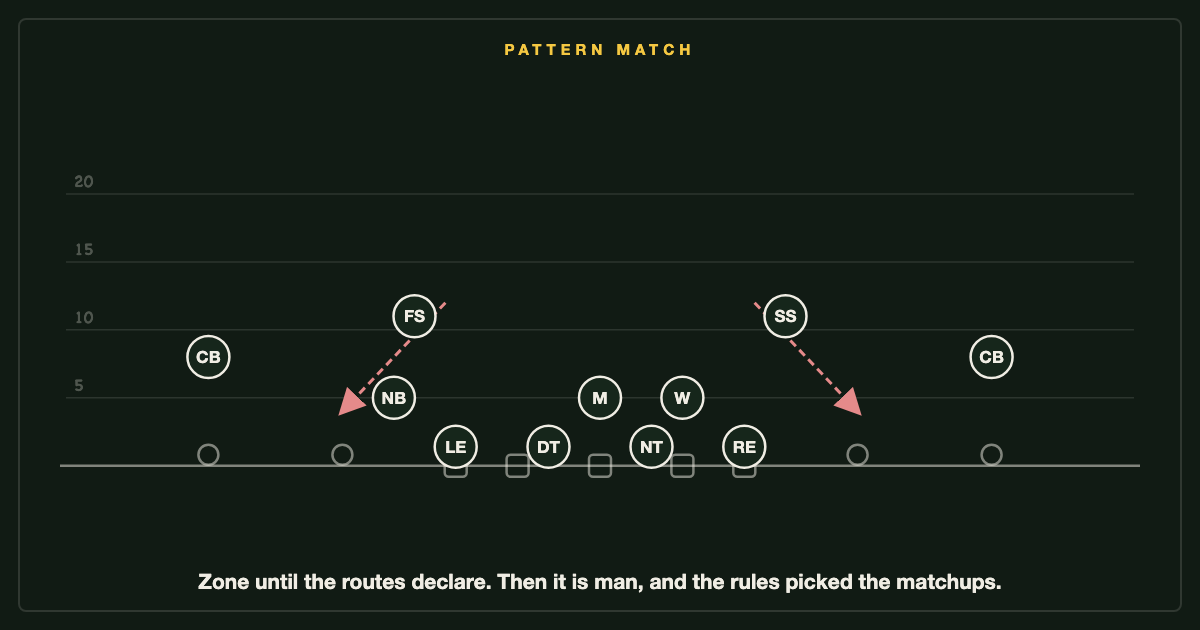
What match is, in one motion
Pattern match is zone coverage that converts to man based on the releases it sees. The standard comparison in the literature is a matchup zone in basketball: defenders start in areas, then pass off and lock onto receivers as the routes distribute, matching the first, second and third receivers counted from the outside in.
The part that matters for your read: the conversion is post-snap by definition. Before the ball moves, a match coverage is indistinguishable from the spot-drop zone wearing the same shell, because the difference is not where anybody stands. It is what they do with a vertical release, and vertical releases have not happened yet.
So the pre-snap picture cannot settle the question. That is not a limitation of your eyes. It is the design.
Cleveland, 1994, and the problem that forced it
The origin is unusually well documented. Nick Saban and Bill Belichick, Cleveland Browns, 1994. They could not beat Pittsburgh, could not stop the Steelers' four vertical concept with traditional Cover 3, and needed to stop the run with one high safety while still playing zone.
Saban's own words on the invention: "We came up with this concept; how we can play cover 1 and cover 3 at the same time, so we can do both these things and one thing would complement the other."
The payoff is stated just as plainly across the sources: pattern matching lets a single-high defense bring an eighth man into the box to stop the run and still not get beaten by four verticals. Zone's run support with man's seam coverage, on the same call. The principles have since spread through the entire league, and the Cover 3 article covers what that does to the most common shell in football.
The two triggers that run the whole machine
The Rip/Liz rules compress into two numbers, both corroborated.
Five yards decides man or zone. If the second receiver breaks under or inside within the first five yards, the seam player makes the Under call, and that side of the defense converts to an ordinary zone. An early break is not worth chasing, so nobody chases it.
Twelve to fifteen yards decides who owns the seam. If the second receiver goes vertical, the curl-flat player walls him and carries him up the seam man-to-man, playing outside-underneath leverage, past twelve to fifteen yards. That is the sentence that killed four verticals: the seam that used to split three deep defenders now has a man defender attached to it before it gets deep.
Behind those triggers, the corner matches the outside receiver on vertical and outside-breaking routes, the inside backers react to the Under call and rob the dig or cut the crossers, and the free safety plays the deep middle with outside leverage on verticals. Every rule is an if-then, and the routes supply the if.
The vocabulary, and the relatives you already know
The named techniques are worth recognizing because coaches say them like common words. MOD, man on demand: the corner plays man if the receiver releases vertically, and zones off if the route breaks early. MEG, man everywhere he goes: the corner mans the outside receiver with no exceptions. Same corner, two different contracts, chosen by call.
Palms is the match family's trap member, a Quarters shell where the corner reads the second receiver to decide his job on the first. Quarters itself runs match rules on every snap, safeties taking the second receiver's vertical past a trigger the sources put at ten or twelve yards, a real recorded conflict. Even the fire zone plays a matchup scheme behind its five rushers, passing receivers off outside-in.
And the contrast case that sharpens all of it: 2-Man is pure man from the snap, no reads, no conversion. Match is not man played early. It is zone that reserves the right.
What it means for your reads
The practical consequence is one sentence: the same pre-snap picture now has two answers, and the routes you send are what force the coverage to pick.
Four verticals against spot-drop Cover 3 is the textbook winner. Four verticals against Rip/Liz is carried man-to-man and dies. The picture was identical. What changed is a rule you could not see, and the only way to see it is to watch what the seam player does with a vertical release, which happens after the snap, in the window the rotation article tells you to spend on the safeties. Post-snap eyes are not a luxury against match teams. They are the read.
The five-yard trigger is also a lever you can pull. Early breaks convert the coverage to zone on purpose, on your schedule. A route under five yards is not just a throw, it is an instruction to the defense, and knowing that turns short routes into probes.
What to do with this on Saturday
The cheat cards teach the honest versions of each coverage. Match is the dishonest version of all of them, so add these:
Send a vertical and watch who carries it. A seam player who turns and runs with the second receiver just declared match. One who sinks to a spot declared zone. One route, full diagnosis.
Respect the two numbers. Under five yards, you are talking to zone. Past twelve to fifteen, your seam runner has a man defender attached. The space between is where match coverage is still deciding.
Stop trusting the four verticals answer until you know which Cover 3 it is. The play that proves the shell is also the play the match version was built to bury.
Use early breaks as instructions. The Under call converts the defense to zone. You can force that call whenever you want it forced.
Pattern match is the defense refusing to answer man or zone until your routes make it answer. Make them answer early, on a play you can afford.
Defense IQ drills the shells and the conversions. Drill both until the read arrives before the thought does.
The reps that build this read live in the Film Room, where the free cheat cards live.
Where this comes from
Every claim above is checkable. These are the published sources behind it, and where they disagree the article says so.