Route Geometry: Why Routes Are Shaped That Way
Defense IQ draws routes as clean lines with fixed depths. The lines are real, but none of them are arbitrary. Every route is an answer to a specific defender's rule.
Once you see routes as answers instead of shapes, the route tree stops being a memory exercise. A dig is a dig because of where linebackers drop. An out breaks where it breaks because of what lives deeper. And the same route changes shape depending on who is chasing it.
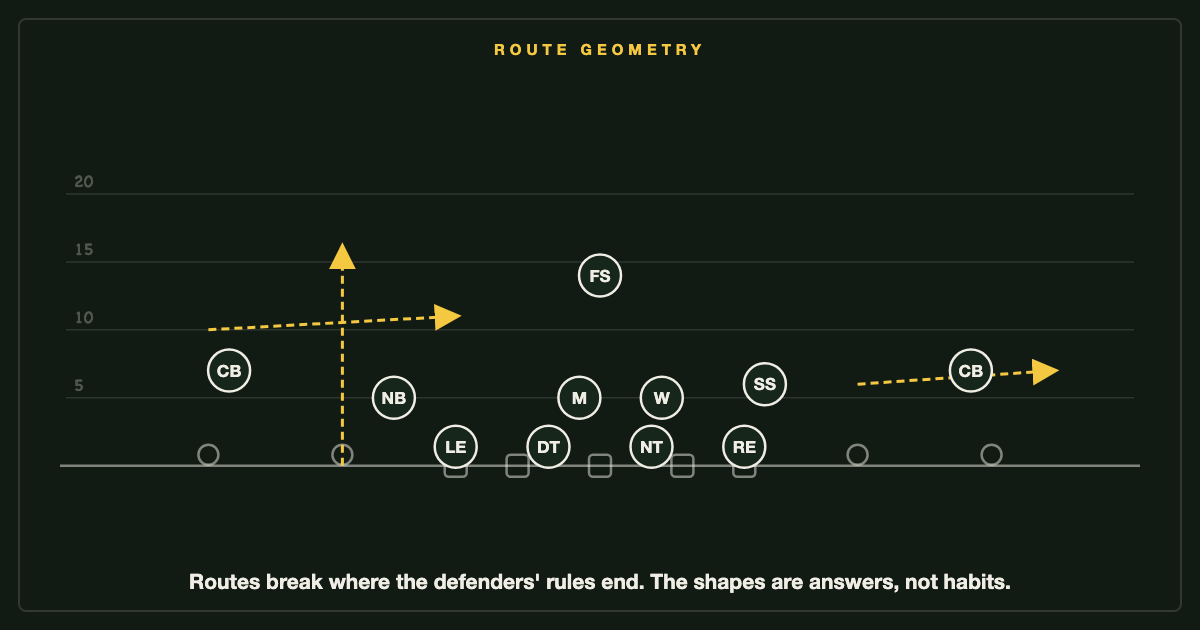
A route is an answer, not a picture
Start with the concept that says it plainest. The published break rule for the option route: if the defender is playing you with inside leverage, whether man or zone, you will probably be most open if you break outside. If he is playing outside leverage, break inside or break inside and sit.
That is the whole philosophy in two sentences. The route's final shape is not chosen in the huddle. It is chosen by the defender, and the receiver just reads the choice. The same source adds the timing half: get open late, when the quarterback is ready to deliver, rather than separating early into a window that will close before the ball can use it.
Fixed routes are the same logic pre-committed. The play caller has guessed the leverage and the coverage, and drawn the answer in advance. Option routes move the decision to after the snap. Both are answering the same question, and the question is always some defender's rule.
Depth is set by the defender's drop
Why is a curl ten to twelve yards? Because the curl-to-flat defender in Cover 3 drops at a 45 degree angle to a depth of ten to twelve yards, holds the curl, then drives to the flat. The curl sits exactly at the edge of that man's rule, deep enough that he must respect it, positioned so his drive to the flat opens it. The route's depth is the defender's depth, on purpose.
The dig lives in the same neighborhood for the same reason. Mills pairs a dig at ten to twelve with a post behind it, high-lowing the play-side safety. The Air Raid option route stays at five to six yards, underneath the linebackers rather than among them, and one install source states the ceiling outright: the receiver should not get deeper than five yards.
Honesty about the numbers: not every depth is settled. The Dagger dig is fifteen yards in Bowen's version, sixteen to eighteen in Weekly Spiral's, twelve to fifteen elsewhere. That is the widest depth disagreement in the research, and it is real variation between systems, not sloppy sources. The principle holds even where the number moves: the dig breaks behind the linebacker level, wherever that level sits in a given scheme.
Landmarks: routes aimed at grass, not at people
Zone routes are aimed at addresses. Four Verticals sends the inside receivers up seams two yards outside the hash marks, a fixed landmark, because that line splits the deep zones of a three-deep shell. The bender adjusts off that landmark by the leverage of the defender, but the landmark comes first.
The Bang 8, the skinny post, cuts at about twelve yards and is usually caught twenty to twenty-two yards deep on the inside edge of the numbers. That catch point is not style. It is the seam between a Cover 2 corner and safety, attacked at the specific depth where neither owns the ball.
Smash shows the other zone tool, the stacked stretch. A hitch at five to six yards and a corner route breaking off a ten to twelve yard stem, both in the same defender's area. The published read is the flat defender, not the receivers: if the corner sinks under the deep route, throw the hitch on time; if he sits low, throw the corner behind him. Two addresses, one resident, and the route depths exist to make his rule unsatisfiable.
The same route changes against man
Against man there is no grass to sit in, so the geometry changes goals: stop answering zones, start answering a human.
Mesh is the taught example. Two crossers intersect at six yards, and the trailing receiver reads the linebacker behind the mesh: against zone, settle up in the window; against man, keep running, because a chasing defender is beaten by continued motion and traffic. Same play, two shapes, chosen after the snap. The stick route runs the same fork, sitting in grass against zone and whipping out to the sideline against man.
The double move only exists because man defenders react to breaks. Sluggo sells the slant to move the corner's hips, then goes. Even its finish is coverage-dependent: down the seam against middle-open looks, toward the outside against middle-closed ones. And the back-shoulder fade is the purest leverage answer in the tree, a purposefully underthrown ball against press man, placed a foot above and behind the back shoulder, where a corner in phase with his back to the ball cannot play it. Trail technique is the defensive mirror of that same fight.
This is why the man-or-zone read is worth three seconds of your pre-snap clock: it decides which shape every route on the field is about to take.
What to do with this on Saturday
The cheat cards teach you coverages. Routes are the answer key, so read them that way:
For every route, name the defender it interrogates. Curl asks the curl-flat player. Smash asks the flat corner. Mills asks the safety. If you cannot name the defender, you do not know the route yet, you only know its picture.
Anchor depths to drops. Underneath zone lives at ten to twelve yards in the base coverages. Routes at five to six run underneath that world, routes at ten to twelve fight inside it, routes behind it live off landmarks in the deep seams.
Watch what a route does at its break. A receiver who settles just told you zone. A receiver who keeps running just told you man. The route is reading the coverage for you, in real time.
Expect the numbers to wobble between systems. The Dagger dig alone spans twelve to eighteen yards across published sources. Learn the level a route attacks, not just its number.
Routes are questions asked at specific addresses. The coverages in Defense IQ are the things being asked.
Drill the coverages, then re-watch the routes against them, until the read arrives before the thought does.
The reps that build this read live in the Film Room, where the free cheat cards live.
Where this comes from
Every claim above is checkable. These are the published sources behind it, and where they disagree the article says so.