Man or Zone: The Three-Second Test
Man or zone is the first fork in every read. Every route changes shape depending on the answer, and the defense gives you about three seconds of pre-snap evidence to work with.
The evidence is rankable. Some tells are leans that lie regularly. One tell is close to a confession. And the strongest test of all, sending a man across the formation, has exactly one known false positive, which is worth more to know than the test itself.
Why this question comes first
Every route on the field is two routes, and the coverage decides which one runs. The stick sits in grass against zone and whips to the sideline against man. Mesh settles in the window against zone and keeps running against man. The whole conversion logic is laid out in the route geometry article, and none of it can start until man-or-zone is answered.
The answer also prices your protections and your fears. Man coverage means picks, rubs and double moves are live, and a scrambling quarterback runs far, because the defenders' backs are turned. Zone means windows and landmarks, defenders with vision on the ball, and interception risk on any throw a squatting defender can see coming.
So the three seconds before the snap are not idle. They are a test you can run in a fixed order.
Eyes first, because eyes outrank everything
Moorhead's checklist puts it second only to counting safeties: do the defensive backs and linebackers show man eyes or zone eyes? Man eyes are locked on a receiver. Zone eyes check the receiver, then find the quarterback. He adds two warnings that make the read honest: this is where defenses work hardest to deceive, and when the other reads blur, the nickel is the most reliable indicator on the field.
The post-snap version of the eyes tell is close to a confession. Saban's man-coverage requirement is a full man turn, the corner rotating until his shoulders are parallel to the line of scrimmage and his back is to the ball. A defender who turns his back on the quarterback has no zone responsibility left, because a zone defender never voluntarily stops seeing the ball. When you watch a corner's back flip toward the passer, the man-or-zone question is over on that side of the field.
The Box D.E.A. framework teaches the same priority from the offense's side: eyes and alignment of the defensive backs sit at the heart of the read, with the caution that it may all change after the snap.
Depth and posture, the leans that lie
Corners within six yards is most likely a type of man coverage. That is a real published rule, and it comes from one document hosted in two places, so weight it as a single source. Press alignment leans the same way, with a named exception: a pressed corner is man, or he is a Cloud corner squatting on the flat with zone behind him.
The reason posture cannot be trusted alone has a championship pedigree. The Seattle Cover 3 was built on press-bail, corners jamming at the line exactly like man defenders and then dropping into deep thirds. An entire era of quarterbacks read press and got zone.
Off coverage lies in the other direction. Seven to eight yards is the standard alignment for Cover 1 man, Cover 3 zone and Cover 4 match alike. And the flat-foot read means an off-man corner stands still through the three-step game, looking for all the world like a zone defender sitting in a window. Depth is a lean. It buys a hypothesis and nothing more.
The motion check, and its one false positive
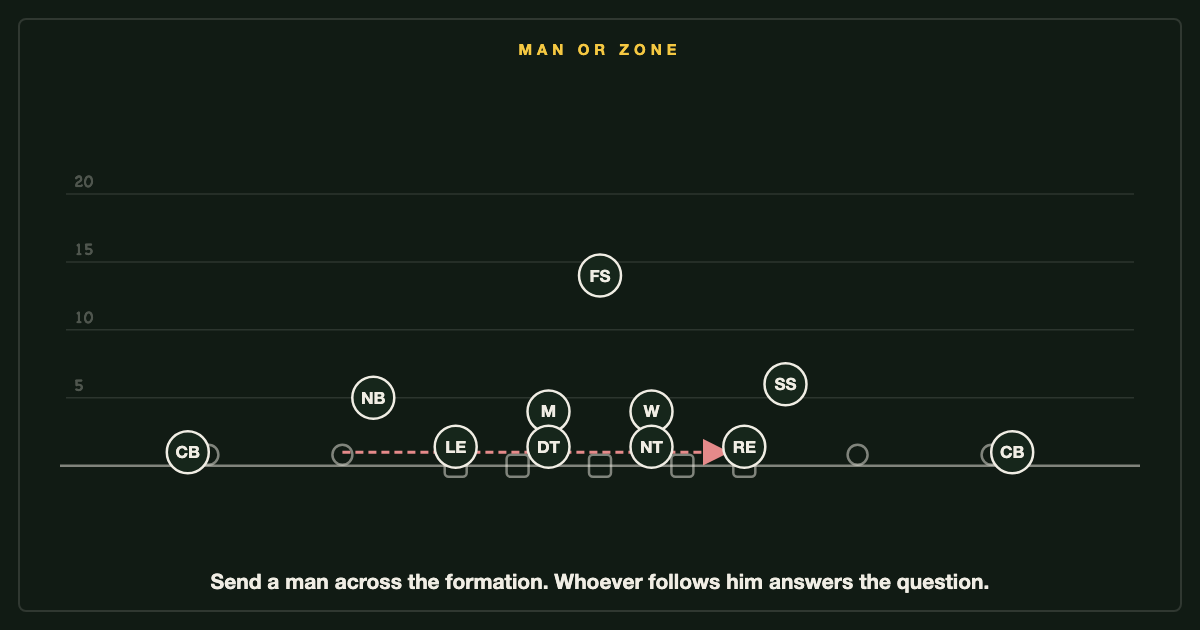
The cleanest test is to make the defense answer a question: send a receiver across the formation and watch who moves.
A defender chasing the motion man across the field is the man answer. Defenders bumping over one spot each, passing the motion along, is the zone answer. This is the standard check, and it is the strongest single piece of evidence available before the snap.
It has one known false positive, and it comes from how defenses declare strength. A zone defense that sets its coverage by passing strength also travels its nickel when motion flips the strength, and the published Cover 8 example shows the whole coverage flipping sides behind that traveling nickel. So travel means man, or it means a strength-set zone adjusting its call. Bump, or no reaction at all, is the more trustworthy half of the test: field-and-boundary zones simply do not care that your receiver moved. The strength rules behind that are in the strength and numbers article.
One more honest limit: the answer can be both. Pattern match coverage is zone at the snap and man after the routes distribute, so the test tells you how the coverage starts, not how it ends.
What each answer buys you
Say the test comes back man. You have bought: rubs and picks, the routes that make defenders run through traffic. Double moves, because man defenders react to breaks with their hips. The back-shoulder throw against press. And the scramble, because nobody is watching the quarterback. You have also bought a warning: with a free safety and a lurker or with trail technique under two safeties, man coverage comes with help, and the help is placed exactly where your favorite inside throw goes.
Say it comes back zone. You have bought windows: settle routes in the seams between defenders, high-lows on the flat defender, landmarks like the hashes and the numbers. You have also bought the zone tax: defenders with eyes on the ball, which means every throw is being watched by people who are allowed to leave their man, and a squatting corner reading the quick game is a turnover waiting on a lazy read.
Either answer is workable. The unworkable thing is not asking.
What to do with this on Saturday
The cheat cards give you coverages with the answer attached. Live football makes you earn it, in order:
Safeties, then eyes. Count the shell first, then read the corners' and nickel's eyes. Locked on hips is man. Checking the backfield is zone. When it blurs, trust the nickel.
Use depth and press as leans only. Inside six leans man. Press leans man or Cloud. Neither is a verdict, and press-bail exists specifically to punish people who think it is.
Motion when you can. Bump is the trustworthy answer. Travel is man or a strength-set zone, so confirm with eyes before you spend a throw on it.
Re-ask after the snap. A corner's full man turn ends the question. A seam defender carrying a vertical tells you the zone just became man. The test is three seconds long, and it does not end at the snap.
Man or zone is the cheapest question on the field to ask and the most expensive one to skip.
Defense IQ drills both answers and the tells between them. Drill them until the read arrives before the thought does.
The reps that build this read live in the Film Room, where the free cheat cards live.
Where this comes from
Every claim above is checkable. These are the published sources behind it, and where they disagree the article says so.