Leverage: The Shade That Tells You the Route
Look at which shoulder the defender takes. Inside eye or outside eye, one step of shade. Defense IQ marks it on the cards, and it is the smallest detail on the field that predicts a route.
Because the shade is not a preference. It is a bet, placed by the coordinator, that whatever the defender concedes will be cleaned up by help standing somewhere specific. Read the shade plus the help and the open route family names itself.
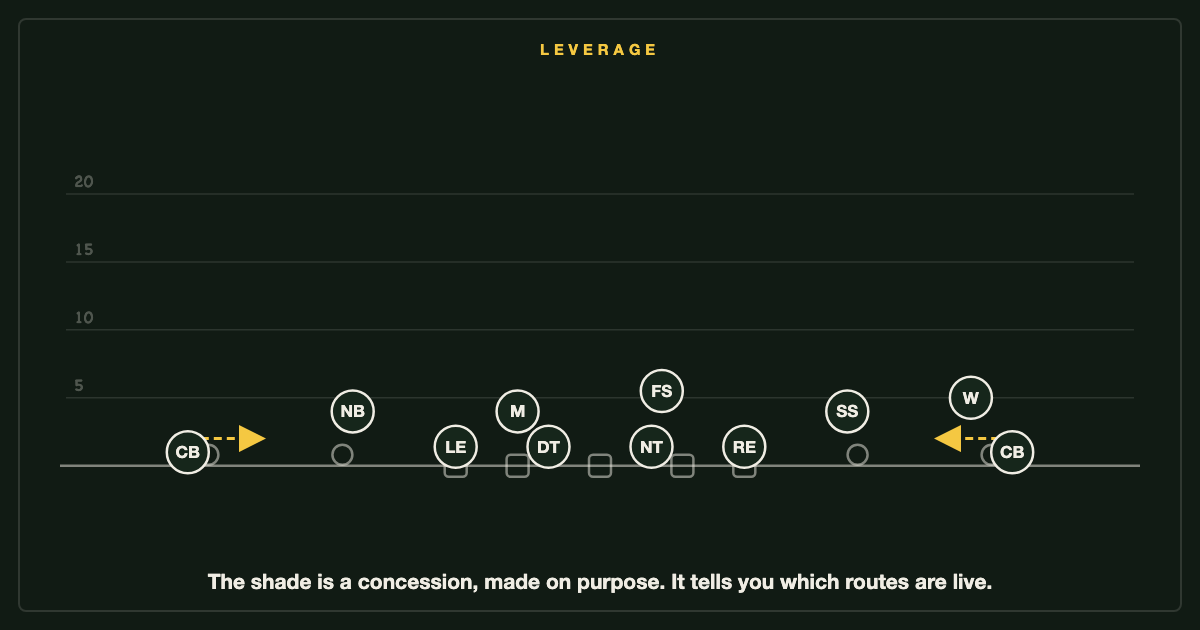
What a shade is: a bet with a named helper
A defender aligned on the receiver's inside eye has physically taken away the inside release and the inside break. Everything outside, the out, the fade, the comeback, he has conceded by geometry. Outside shade is the mirror: outside routes are contested, inside routes are conceded.
No coordinator concedes half a route tree for free. The shade always points at help. The conceded side is covered by someone or something else, and the whole skill of reading leverage is naming that someone. Sometimes it is a safety. Sometimes it is a lurking linebacker. Sometimes it is the sideline itself.
Which means leverage is two reads in one: the shade tells you what the defender concedes, and the help location tells you whether the concession is real. That pairing runs the rest of this article.
The mirrored pair that proves the rule
The cleanest documented case is the pair the research calls the best recognition card in the entire run: Cover 0 and Cover 1, two press pictures that look identical, separated by one shoulder.
Cover 0 defenders play from an inside shade with no help in the middle of the field, and the coaching catechism answers where the help is: the sideline. Every inside-breaking route, the slants and digs and crossers, is what the alignment exists to erase, and the boundary is trusted to handle what leaks outside.
Cover 1 flips the shoulder because it flipped the helper. Defenders align with an outside shade and funnel routes to the free safety in the middle of the field. Outside breaks are contested by alignment; inside breaks are herded toward the one man standing where they go.
Same press picture, opposite shade, opposite open routes. If you learn one leverage fact, learn this pair, because it converts one glance at a corner's feet into a coverage identification.
The refinement real coaches play
The always-outside and always-inside versions are simplifications, and the best documented rule set says so. Saban's line of demarcation sits one yard inside the top of the numbers, ten yards from the sideline. If the receiver aligns outside that line, the defender plays inside leverage. Inside it, outside leverage.
The logic is field geometry. A receiver crowding the sideline has already spent his outside room, so the defender takes away the inside and lets the boundary keep doing its work. A receiver aligned tight to the formation has field on both sides, so the defender pushes him toward the middle help. The shade is being set by real estate, not by habit.
For your read, that adds one instruction: check the receiver's split before you interpret the shade. A shade that looks like a coverage tell may just be the demarcation rule responding to where the receiver stood. The two reads separate cleanly once you know both exist.
Leverage plus help, coverage by coverage
Run the shade-plus-help pairing across the coverages and each one's open family falls out.
2-Man plays inside leverage underneath, trail technique on the receiver's inside hip, because the help is two safeties above and behind. The concession is in front and outside, which is exactly the published soft spot: quick outs, hitches, the ball thrown in front and away from the inside hip.
Palms aligns its corners at six to eight yards with outside leverage, and the install source names the reason: to defend the bubble. The trap rule even attacks with outside leverage on the quick throw, the corner hammering down on an early out. There the shade is not conceding the outside. It is hunting it.
And the offense reads the same alignment in reverse. The option route's published break rule is leverage stated from the receiver's side: inside leverage, break outside. Outside leverage, break inside and sit. The receiver and the defender are reading the same shoulder, which is why route geometry and leverage are one subject wearing two jerseys.
When the shade lies
Leverage is alignment, and alignment is the cheapest thing on the field to fake. Three honest cautions.
First, depth changes what a shade means. The Cover 0 sources disagree about whether zero defenders press or sit at eight yards, and both agree only on the inside shade. An off defender with inside shade drives downhill on the throw; a pressed one denies the release. Same bet, different collection method, so read shade and depth together.
Second, match rules can change the defender's assignment mid-route, and with it the meaning of his starting shade. The Palms corner's outside leverage on the outside receiver becomes a downhill attack on the slot's out route because an if statement fired, not because the shade lied about the man.
Third, the help can be a person you have not found yet. Cover 1's outside shade funnels you inside, and the funnel sometimes empties onto a robber whose whole job is catching what the shade herded to him. A shade read without a help read is half a read, and the half you skipped is where interceptions live.
What to do with this on Saturday
The cheat cards mark the shades. This is how to spend them:
Read the shoulder, then name the helper. Inside shade with an empty middle means the sideline is the help, and the outside-breaking family is live. Outside shade with a middle safety means the funnel is on, and inside throws are throwing into the help.
Check the split before you trust the shade. A receiver tight to the numbers changes the leverage rule by itself. Wide splits make shades mean coverage; tight splits make them mean geometry.
Pair shade with depth. Press inside-shade denies the release. Off inside-shade sits on the break and drives. The open route family is the same; the timing that beats it is not.
Assume every shade has a reason. When a shade looks wrong for the coverage you diagnosed, the diagnosis is what is wrong. A Quarters corner suddenly outside-leveraged and staring at the slot is a trap announcing itself.
Leverage is the defense writing its bet on the ground before the snap. Learn to read the handwriting.
Defense IQ marks leverage on every card that has it. Drill it until the read arrives before the thought does.
The reps that build this read live in the Film Room, where the free cheat cards live.
Where this comes from
Every claim above is checkable. These are the published sources behind it, and where they disagree the article says so.