Safety Rotation: The Defense Moves After You Look
Defense IQ teaches you to count the safeties and name the shell. Real defenses know you are doing that, and they wait until you have looked before they move.
Rotation is not chaos and it is not cheating. It is a scheduled move with named versions and a fixed grammar, and the fact that it happens after your pre-snap look is the whole point of it. Learn the grammar and the late picture becomes readable too.
The shell is a photograph of a moving thing
Defenses show two-high before the snap and spin to single-high after it, and the published framing is blunt about why: modern post-snap movement is designed to keep quarterbacks blind to the rush and the coverage. The rotation can begin at the millisecond of the snap, which forces the identification to happen post-snap or not at all.
Vic Fangio is credited with pioneering the two-high shell system at the NFL level, and once he proved a split-field shell could work there, the college game adopted it widely. The two-high picture became the default costume, and the spin became the reveal.
The word spin itself carries a warning. Dub Maddox uses it for the whole rotation, beginning the moment a safety rotates off the hash after the snap. MatchQuarters uses the same word for something narrower, a call for safeties to exchange responsibilities on motion. Two meanings, one word, both in print. When a coach says spin, ask which one he means.
The triangle, the cleanest frame in the literature
Maddox's teaching system reduces all zone rotation to three triangles occupying the same three spaces: flat, hook, deep. Only the occupants rotate.
Cloud puts the corner in the flat, backer in the hook, safety deep. Sky puts the safety in the flat, backer in the hook, corner deep. Buzz puts the backer in the flat, safety in the hook, corner deep. The first letter names who has the flat and the force, Corner, Safety, Backer, and that mnemonic is corroborated across three independent sources.
The quarterback's primary read collapses to one question: who gets to the flat first? Answer that and you have identified the rotation without naming it, because the three triangles only differ in who makes that trip. The Cover 3 article shows the same three names from the coverage side.
Maddox adds an organizing rule for pressure: spin to the backside is stable, spin to the frontside is pressure. The backside of a rotation settles into a predictable triangle regardless of personnel, corner deep, outside backer flat, inside backer hook. The frontside rebuilds into Cloud, Sky or Buzz. One sentence, and half the post-snap picture is already known.
The spin-down, and what it is for
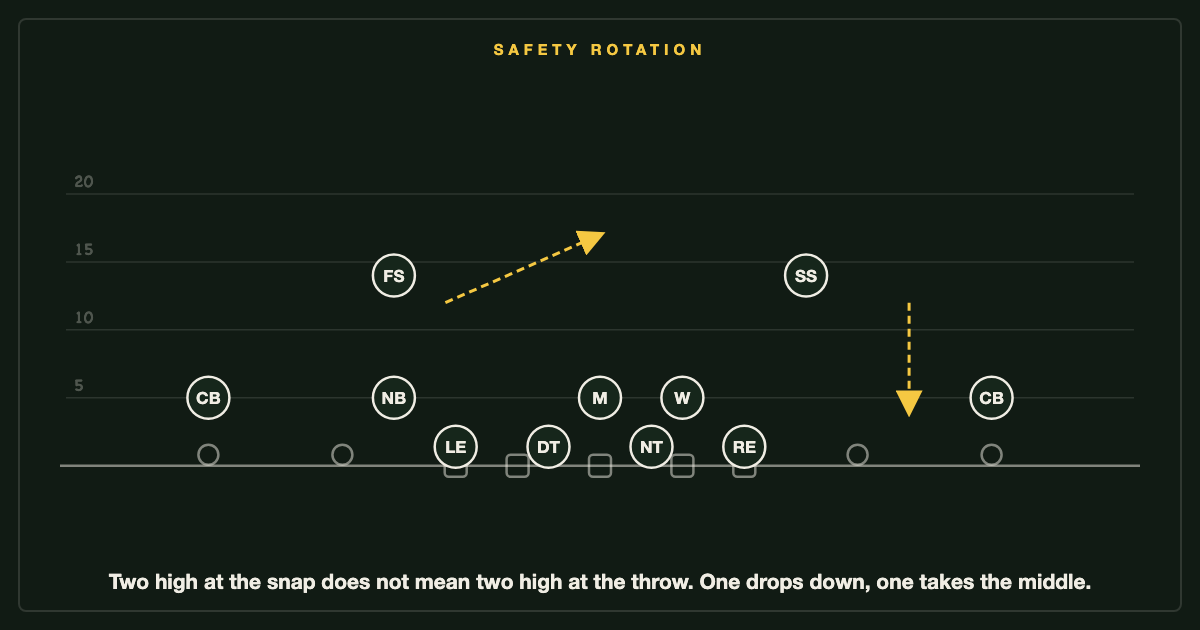
The signature move is two-high to single-high: one safety drops toward the box or the hook, the other slides to the deep middle, and the middle-of-field-open picture you read becomes middle-closed while your eyes are on your first step.
The published reason is play-action. Showing two-high keeps the light box that invites the run, and spinning down after the snap answers the run without having lived in the run-stopping shell. The defense gets to be two things, in sequence, and the offense only got to look at the first one.
The same trick runs in reverse and sideways. Cover 1 Robber resolves late out of a two-high shell. Cover 3 Buzz presents a two-deep look before the safety sinks into the hook. Rip and Liz, in Saban's system, are literally the safety announcing which side he is coming down to, so the whole defense bumps its alignment around a declared rotation. The rotation is not an exception to the coverage. Often it is the coverage's delivery mechanism.
Why timing is the whole disguise
Here is the economic logic. A defense that aligns in its true coverage gives you the full pre-snap clock, from the huddle break to the snap, to diagnose it. A defense that rotates at the snap gives you nothing usable before the ball moves and a fraction of a second after it.
That is why rotation timing, not rotation shape, is the disguise engine. The shapes are only three triangles. The weapon is when they assemble. A shown shell is a claim about the future, and the later the defense converts the claim into the truth, the less of your drop remains to exploit the answer. This is the mechanical reason the pre-snap article keeps calling the look a claim, and the reason the disguise article says most coverages borrow another shell's picture.
The countermeasure is also published. Moorhead's String Principle covers the pre-snap half: every second and third level defender is tied to a string, so a safety creeping or a backer walking out signals the coordinated rotation early. Defenders leaning and creeping toward the line are the same string showing.
How to catch it moving
The published quarterback drill: take a quick three-step drop with eyes locked on the safeties, confirming post-snap movement before looking at receivers. The first step should confirm or change the pre-snap diagnosis. Not the fifth step. The first.
The confirmations are simple enough to say out loud. Both safeties gaining depth and splitting to halves is Cover 2 country. One safety working to the deep middle while the other rotates down or works laterally is likely Cover 3 or Cover 1, and the man-or-zone question resolves from there with the eyes and leverage checks.
Notice what this does to your pre-snap read: it does not replace it, it prices it. The shell gives you a hypothesis for free. The safeties' first two steps tell you whether to keep it.
What to do with this on Saturday
The cheat cards freeze the picture. Rotation is the argument for reading the unfrozen one:
Read the shell, then hold it loosely. Two-high before the snap constrains nothing by itself. It is the most borrowed costume in football.
Eyes on the safeties for your first step. Depth-and-split is two-high truth. One man crashing while the other centers is the spin-down, and the middle just closed.
Ask who gets to the flat first. Corner, safety or backer. That one answer names the frontside triangle, and the backside is stable by rule.
Watch for the string before the snap. A creeping safety is not one man moving. He is the first visible piece of a rotation that has already been called.
The defense is allowed to move after you look. The answer is not to look harder at the frozen picture. It is to know the three shapes the moving picture can become.
Defense IQ drills the shells and the rotations both. Drill them until the read arrives before the thought does.
The reps that build this read live in the Film Room, where the free cheat cards live.
Where this comes from
Every claim above is checkable. These are the published sources behind it, and where they disagree the article says so.