The Mike Point: Why Quarterbacks Shout a Number Before the Snap
Before most NFL snaps, the quarterback points at a defender and shouts a jersey number. Fifty-three is the Mike. Fifty is the Mike. Defense IQ teaches you to read the defense; this is the offense reading it out loud.
The shout is not about the man. It is about the count. Declaring the Mike sets the center of the protection, and everything that happens to the quarterback in the next four seconds, including whether he has to throw hot, is decided by that arithmetic before the ball moves.
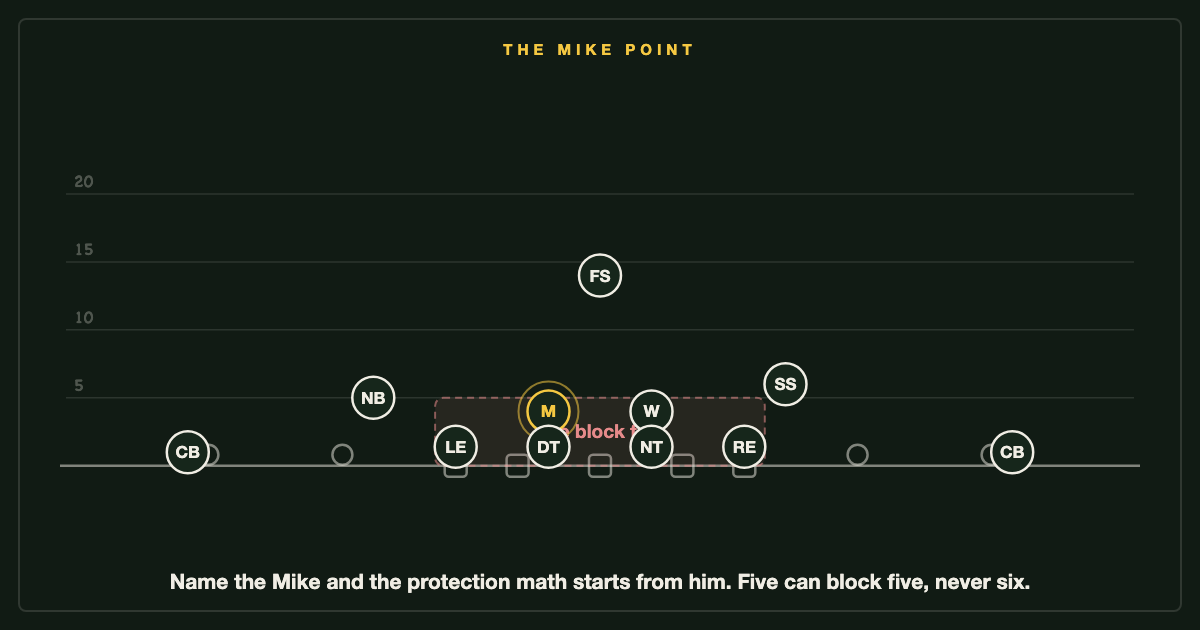
What the shout actually does
The Mike declaration is the offense announcing who the pass protection is built around. Once the Mike is identified, the center knows which direction he is going to work, and the running back knows which way he will initially work. One call, and six people's assignments resolve at once.
Structurally it establishes a balanced three-by-three protection, three blockers responsible to either side of the declared point, which one published coaching source calls the foundation of essentially every NFL pass protection scheme, built with an inside-out approach.
Who makes the call varies. Usually the quarterback. Some teams have the center do it, Green Bay is the named example. Either way the mechanism is the same: point, number, and the protection snaps into shape around the named man.
The point is about counting, not the man's name
The most misunderstood fact about the Mike point: the declared Mike is not necessarily the actual middle linebacker. He is the Mike as defined by the offense, and changing who the Mike is can be as simple as saying a different number.
What the offense is really doing is placing the center of a count. The published rules that govern the choice: protection is set inside-out, most dangerous first, where dangerous means closest to the quarterback. The slide is set based on the potential rusher most likely to affect the center, and the center must honor that defender until it is confirmed he is not blitzing. Big on big, back on backer: linemen take linemen, the back takes the declared threat. The uncovered lineman works with the man inside him toward the Mike.
One honesty note: no public source found in the research gives a single universal rule for which defender becomes the Mike across all fronts. Systems differ, and the counting has to be practiced daily so the reaction to a front is a reflex rather than a thought process. That last line is a direct coaching prescription, and it is the same prescription Defense IQ makes about reads.
Five can block five, but not six
Here is the arithmetic underneath every protection call. Five linemen can handle five rushers. The back adds a sixth blocker for a sixth threat, working inside-out to find the most dangerous rusher the linemen did not account for. Send more than the protection can count, and somebody runs free.
The defense knows this math too, which is why the published protection-count rule is worth memorizing: a seven-man protection prevents the defense from forcing a hot throw at all, because the only way to force one is to send a secondary defender, and sending a secondary defender means playing Cover 0 behind it.
One published letter system makes the count audible. Q is the defender the quarterback himself is responsible for: if the Q linebacker blitzes, the quarterback must throw before he arrives. R is the inside linebacker the back reads first. B, the system calls him the Bastard, is the outside backer left unblocked if both he and the inside backer come. The protection does not pretend to block everyone. It decides, in advance, who goes unblocked and what the answer is when he comes.
How defenses attack the declaration
Because the Mike point is a count, the defense attacks the count rather than the blockers.
Re-Mike. A named defensive goal: force the offensive line to identify a different primary linebacker than originally planned, by alignment and late movement, so the protection's center is wrong at the snap.
The overload. Blitzes built to bring one more than the protection can handle, and the coaching source is explicit that the key to a successful blitz is in the disguise. The count cannot solve a rusher it never counted.
Mugging the A gaps. Two backers walk up over the center's gaps while the linemen shade out wide, targeting the two weakest points in protection, the center and the running back. Mike Zimmer and the late Jim Johnson helped take the tactic, also called sugaring, mainstream. And a mugged backer is not a promise: the same alignment is used to disguise coverage, backers dropping out while the pressure comes from somewhere else. The fire zone article is that idea grown into a whole system.
The offense's answer calls
The declaration comes with a toolbox of adjustments, and one published NFL system names four. Kick It slides the protection to a walked-up edge rusher. Gap answers blitzers away from the Mike side. Max adds a tight end for seven-man protection. Big goes to a four-by-two structure against overload looks.
Notice what Max buys, because it closes the loop on the count: seven blockers means no forced hot read, which means the defense either rushes into a wall or backs out. Every one of these calls is the same move, re-centering the count after the defense tried to move it.
This is why the Mike point belongs in a recognition app for people who never block anyone. The declaration is the offense doing, out loud, exactly what you are training to do silently: count the threats, find the most dangerous one, and build the plan around him. The strength and numbers article is the defense running the same arithmetic in the other direction.
What to do with this on Saturday
You are not calling protections. You are reading the same picture the quarterback reads, so borrow his order:
Find the count before the snap. How many possible rushers inside the box, against how many blockers. Five against five is quiet. Five against six means someone throws hot or someone runs free.
Watch what the point does to the defense. Backers who walked up sometimes back out the moment the Mike is declared, because their job was to poison the count, not to rush.
Treat mugged backers as a question, not an answer. Two men over the A gaps is either six rushers or four with a costume on. The count only resolves at the snap.
Remember who the count says is unblocked. Every protection leaves someone. The offense knows who, and the hot throw is aimed where that man came from.
The Mike point is a count spoken out loud. Learn to run it silently and you are reading protections like a quarterback.
Defense IQ drills the defensive half of this picture. This gives you the offense's half. Drill both until the read arrives before the thought does.
The reps that build this read live in the Film Room, where the free cheat cards live.
Where this comes from
Every claim above is checkable. These are the published sources behind it, and where they disagree the article says so.